Introduction
Tapentadol and tramadol occupy the same therapeutic niche: moderate to severe pain that hasn’t responded adequately to non-opioid analgesics. Both are centrally acting opioid analgesics, and both pair mu-opioid receptor activity with a second, non-opioid mechanism. The similarities largely end there.
The two differ meaningfully in potency, onset, metabolic pathway, interaction profile, tolerability, and the clinical scenarios where each performs best — differences that often determine which drug a prescriber selects and how well a patient tolerates it. Understanding them turns a passive prescription into an informed conversation with your healthcare provider.
What is Tapentadol?
Tapentadol is a centrally acting opioid analgesic indicated for moderate to severe acute pain and for selected chronic pain conditions. It exerts its effect through two complementary mechanisms:
- Mu-opioid receptor (MOR) agonism — attenuating pain perception at the level of the brain and spinal cord.
- Norepinephrine reuptake inhibition—potentiating descending inhibitory pain pathways.
Two features distinguish it from tramadol. Tapentadol has minimal serotonergic activity, and it is pharmacologically active as administered rather than requiring metabolic conversion. Together these translate to a more rapid onset of analgesia and markedly less inter-patient variability, since the drug’s effect does not hinge on individual enzyme activity.
One small note on accuracy: the phrase “does not require significant metabolic activation” is worth tightening to “requires no metabolic activation” – tapentadol has no active metabolites at all, so the hedge undersells a genuinely clean point of difference.
What is Tramadol?
Tramadol is a prescription opioid analgesic indicated for moderate to moderately severe pain. Like tapentadol, it acts through more than one pathway:
- Weak mu-opioid receptor agonism.
- Dual serotonin and norepinephrine reuptake inhibition, augmenting descending inhibitory control of pain.
Tramadol is a prodrug. Its opioid activity derives largely from O-desmethyltramadol (M1), generated by hepatic CYP2D6 and substantially more potent at the mu receptor than the parent compound. CYP2D6 expression varies widely across the population, so analgesic response is correspondingly variable — poor metabolizers may obtain little relief, while ultra-rapid metabolizers are exposed to disproportionately high metabolite concentrations and greater toxicity risk.
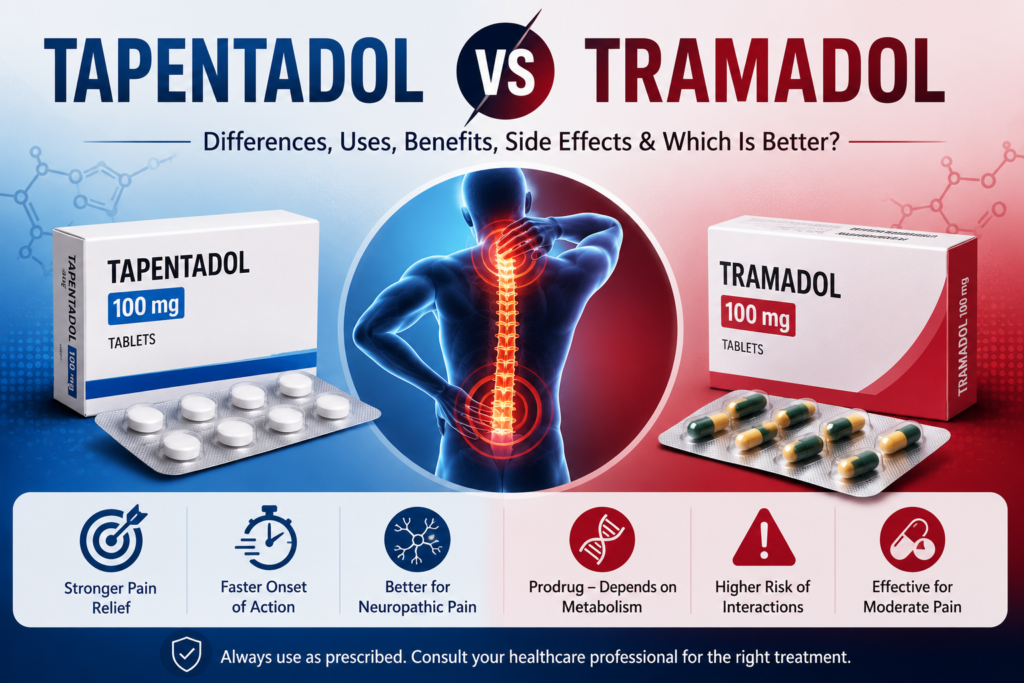
Tapentadol vs Tramadol: Key Differences
| Feature | Tapentadol | Tramadol |
|---|---|---|
| Drug Class | Opioid analgesic | Opioid analgesic |
| Potency | Generally more potent | Less potent |
| Mechanism | Mu-opioid agonist + norepinephrine reuptake inhibitor | Weak mu-opioid agonist + serotonin and norepinephrine reuptake inhibitor |
| Prodrug | No | Yes |
| Onset of Action | Faster | Slightly slower |
| Risk of Serotonin Syndrome | Lower | Higher |
| Dependence Potential | Present | Present |
Benefits of each
Tramadol’s advantages: lower abuse-potential classification, cheaper, familiar to most prescribers, and its serotonergic action can help some neuropathic pain. Milder respiratory depression at therapeutic doses.
Tapentadol’s advantages: consistent response regardless of genetics, far fewer drug interactions, considerably better GI tolerability at equianalgesic doses (which improves adherence in chronic use), and genuine efficacy in severe and neuropathic pain where tramadol often falls short.
Which Medication is Stronger?
Tapentadol is the more potent of the two agents and generally produces a faster onset of analgesia. Requiring no metabolic activation, it delivers a predictable response across patients. Tramadol does not: its analgesic effect hinges on hepatic conversion, and the efficiency of that conversion varies substantially between individuals.
Potency, however, is not the same as suitability. Drug selection depends on pain type and severity, comorbidities, age, renal and hepatic function, and the potential for interactions with existing medications — considerations that frequently favour the weaker agent.
Side Effects
Shared: nausea, vomiting, constipation, dizziness, drowsiness, dry mouth, headache, sweating, itching. Both cause physical dependence, withdrawal on abrupt cessation, and respiratory depression in overdose — dangerous when combined with alcohol, benzodiazepines, or other CNS depressants.
More tramadol-specific: seizures (especially above recommended doses or with antidepressants), serotonin syndrome, hyponatremia, unpredictable analgesia. Contraindicated in children under 12.
More tapentadol-specific: somewhat more sedation and euphoria-related abuse potential; higher schedule reflects that.
Drug Interactions
Both medications can interact with numerous prescription medicines.
Particular caution should be taken with:
- Antidepressants (SSRIs, SNRIs, MAOIs)
- Sleeping medications
- Anxiety medications
- Alcohol
- Other opioid pain medicines
Tramadol carries a higher risk of serotonin syndrome because of its serotonin reuptake inhibition. Combining it with serotonergic medications should only be done under medical supervision.
Use During Pregnancy and Breastfeeding
Neither tapentadol nor tramadol should be used during pregnancy or while breastfeeding unless specifically recommended by a healthcare provider.
Long-term opioid use during pregnancy may cause neonatal opioid withdrawal syndrome in newborns.
Both medicines may also pass into breast milk and could affect nursing infants.
Can These Medicines Be Addictive?
Yes.
Both tapentadol and tramadol are controlled prescription medications with the potential for misuse, dependence, and addiction.
To reduce risks:
- Take the medicine exactly as prescribed.
- Never increase the dose without medical advice.
- Do not stop treatment suddenly after prolonged use.
- Keep medicines securely stored away from children.
Tapentadol vs Tramadol: Which One Should You Choose?
Neither is universally better — it depends on the clinical picture:
- Moderate pain, short course, cost matters → tramadol is reasonable.
- Severe pain, or chronic use where nausea/constipation would derail treatment → tapentadol.
- Patients on SSRIs/SNRIs, or with seizure history → tapentadol is the safer of the two.
- Neuropathic pain, particularly diabetic neuropathy → tapentadol ER has the stronger evidence base.
- Poor pain relief on tramadol despite adequate dosing → possible CYP2D6 poor metabolism; switching to tapentadol often helps.
Both are prescription-only and controlled substances in most countries, including India, where tramadol and tapentadol are regulated under Schedule H1 and their sale requires a prescription with mandatory record-keeping. Dose selection, switching between them, and tapering all need a physician’s involvement — cross-tapering opioids without supervision risks both withdrawal and overdose.
Conclusion
Tapentadol and tramadol are both effective prescription medications for managing moderate to severe pain, but they differ in potency, mechanism of action, metabolism, and safety considerations. Tapentadol generally offers stronger and more predictable pain relief, while tramadol remains a widely used option for moderate pain management.
Regardless of which medication is prescribed, it is important to follow your healthcare provider’s instructions carefully, avoid misuse, and be aware of potential side effects and interactions. Responsible use helps maximise pain relief while minimising the risks associated with opioid medications.